On 19 November 2026, Russell Bedford KTC hosted its online Tax Talk: Tax Incentives for Businesses, welcoming nearly 80 business representatives and invited guests. The session provided updates on Vietnam’s 2026 tax incentive regulations, clarified eligibility requirements, and explored practical challenges businesses face when determining, claiming, and maintaining their entitlement to tax incentives.
As Vietnam’s tax landscape continues to evolve, tax incentives offer businesses opportunities to reduce their tax liabilities, but they also bring important compliance, accounting, and documentation requirements. Operating in an encouraged investment sector does not necessarily mean that a business automatically qualifies for preferential tax treatment. Similarly, changes to investment projects, business activities, or corporate structures may affect the scope and duration of existing tax incentives.
How can businesses identify the incentives available to them, apply the regulations correctly, and minimize risks during tax inspections? These questions were central to the discussions at this Tax Talk.
1. Insights from Tax Administration and Business Advisory Experts
The session featured two main speakers: Ms. Nguyen Thi Hanh – Tax Expert and Ms. Thai Thi Van Anh (FCCA, Vietnam CPA, MA) – Partner, Russell Bedford KTC. The programme also welcomed guest tax experts who have served or are currently serving within Vietnam’s tax administration system, contributing valuable insights from their experience in tax administration and the practical application of tax policies.
Bringing together expertise in tax administration, audit, and business advisory, the session examined tax incentives from multiple perspectives, including regulatory requirements, compliance obligations, and challenges encountered in practice. For businesses, understanding the legislation is only the starting point. Equally important is determining how the rules apply to specific business activities, investment projects, and circumstances, as well as maintaining sufficient evidence to support their entitlement to preferential tax treatment.
2. Key Regulations and Principles Governing Corporate Income Tax Incentives
A central focus of the session was an overview of the fundamental principles and regulations governing Corporate Income Tax (CIT) incentives, including eligibility criteria, preferential tax rates, tax exemption and reduction periods, and key considerations for implementation.
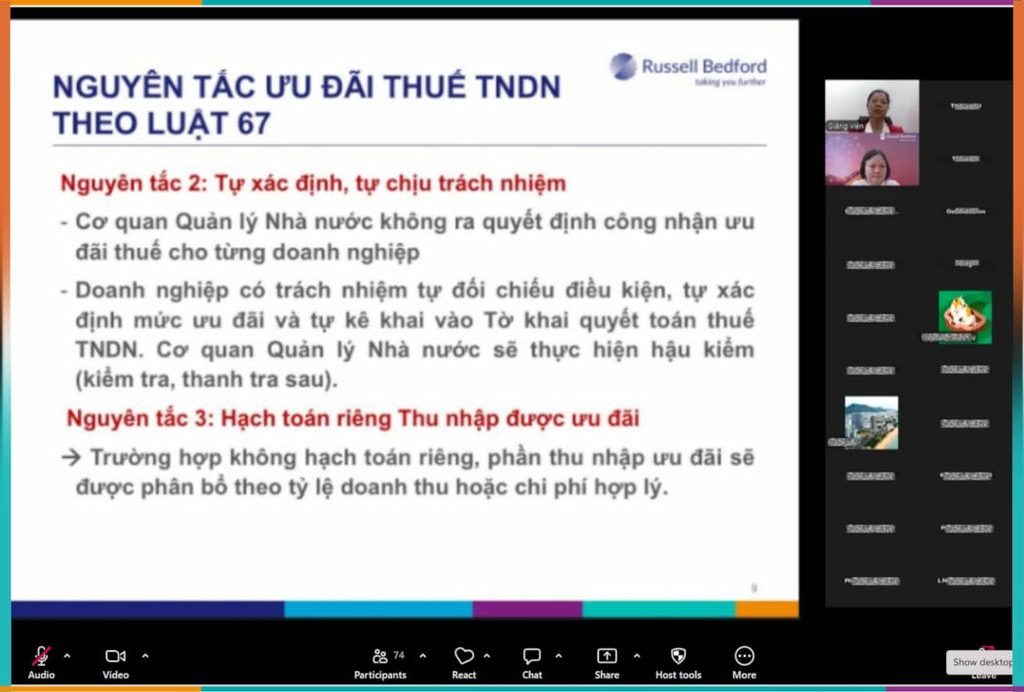
The discussions covered incentives available to new investment projects and businesses operating in encouraged sectors, including high technology, digital technology, software development, semiconductor manufacturing, research and development, and education and training. Eligibility for each sector must be assessed against the relevant legal requirements, taking into account the nature of the business activities and the characteristics of the investment project.
Beyond identifying applicable tax rates and incentive periods, the session highlighted several important principles businesses should consider:
- Self-assessment and accountability: Businesses are responsible for assessing whether they meet the applicable conditions, determining the incentives they are entitled to claim, and making the appropriate tax declarations.
- Accurate identification of qualifying income: Not all income earned by a business automatically qualifies for the same preferential CIT treatment.
- Appropriate accounting and allocation: Income from qualifying and non-qualifying activities must be properly identified, while the allocation of related expenses should be supported by reasonable and consistent grounds.
- Supporting documentation: Investment records, accounting documents, supporting evidence, and other relevant materials should demonstrate compliance with the applicable incentive conditions.
Claiming tax incentives is therefore not simply a matter of applying a preferential tax rate. It is closely linked to accounting systems, documentation management, and a business’s ability to substantiate its tax position. This becomes particularly important under Vietnam’s self-assessment and post-filing tax inspection framework, where the completeness and consistency of supporting records can be critical to defending legitimate tax incentive claims.
3. From Regulatory Requirements to Real-World Business Challenges
The interactive discussion and Q&A session generated a wide range of detailed questions from participants, reflecting the diverse challenges businesses face in investment activities, corporate structuring, and tax compliance.
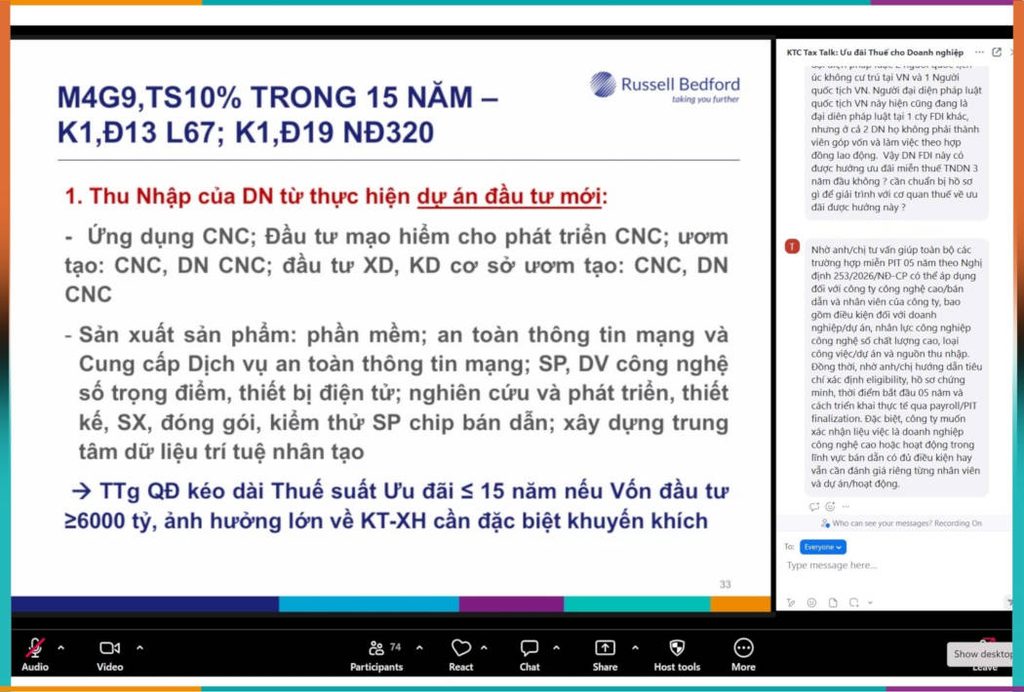
Notably, many questions went beyond whether a business initially qualifies for tax incentives to explore how changes in its operations, investment projects, or corporate structure might affect its continued eligibility.
3.1. FDI Enterprises: Incentive Eligibility and Supporting Documentation
One case raised during the session concerned a foreign-invested enterprise (FDI enterprise) involving Vietnamese nationals in its legal representation, ownership, and business arrangements. The participant sought clarification on whether these characteristics could affect the enterprise’s eligibility for CIT incentives and what documentation would be required to substantiate and explain its incentive claims to the tax authorities.
The case highlighted the importance of assessing tax incentive eligibility against specific legal requirements, investment records, and actual business operations. Relying solely on an enterprise’s investment form or an individual aspect of its ownership or management structure may not provide a sufficient basis for determining its entitlement to preferential tax treatment.
3.2. Investment Project Adjustments and Risks to Existing Tax Incentives
Another major area of discussion concerned how changes to investment projects and business operations may affect tax incentives already being claimed. This is particularly relevant to FDI enterprises, businesses operating multiple projects, and companies planning to expand or restructure their operations.
Participants raised several practical questions:
- Amendments to Investment Registration Certificates (IRCs): Could changes to an IRC affect existing CIT incentives?
- Project expansion and additional activities: Can existing operations and newly added or expanded activities be separately identified for tax incentive purposes?
- Capital increases and new business activities: Could changes in investment capital, project scale, or business scope trigger a reassessment of incentive eligibility?
- Corporate restructuring: What factors should businesses consider when reorganizing their operations while seeking to preserve their legitimate tax incentive entitlements?
These questions underscore the importance of assessing tax implications at the planning stage of an investment adjustment, expansion, or restructuring, rather than waiting until the annual CIT finalization process. Early assessment can help businesses identify the conditions that must continue to be satisfied, documentation that may need to be updated, and potential compliance risks arising from proposed changes.
3.3. Tax Incentives for Newly Established Enterprises, High-Tech Activities, and Education
Participants also sought clarification on tax exemptions and reductions for enterprises established in 2026, as well as incentives applicable to high-tech industries, digital technology activities, and the education sector.
For technology-related activities, questions focused on eligibility requirements and supporting documentation for Personal Income Tax (PIT) incentives available to qualifying high-tech and digital technology professionals. Participants were particularly interested in the scope of eligible employment activities or projects, evidence required to establish eligibility, and the commencement of applicable incentive periods.
In the education sector, discussions addressed postgraduate education, non-public educational institutions, and not-for-profit operating models. These cases raised questions about how tax incentives should be assessed in light of the nature of educational activities, the institution’s legal status, and the specific conditions prescribed by the applicable regulations.
Together, these questions reflected a growing need among businesses to understand not only which tax incentives may be available, but also the precise conditions, supporting evidence, and implementation requirements relevant to their particular business models.
4. What Should Businesses Do to Safeguard Their Tax Incentive Entitlements?
A recurring theme throughout the discussions was that falling within a potentially eligible category does not automatically mean that a business satisfies all the conditions required to claim tax incentives. To manage this risk, businesses should proactively review their existing incentive arrangements against the applicable regulations, investment documentation, and actual operating circumstances.
Such reviews should extend beyond preferential tax rates and exemption periods to examine the scope of qualifying income, accounting treatment, supporting documentation, and any changes that may affect ongoing eligibility. For businesses with multiple investment projects, diversified activities, or expansion and restructuring plans, particular attention should be paid to consistency between investment records, accounting data, and tax filings.
The final months of 2026 provide an important opportunity for businesses to reassess their tax incentive positions ahead of the annual CIT finalization. Early preparation allows finance and accounting teams, together with management, to identify issues requiring clarification, evaluate potential tax benefits, and address compliance risks before they develop into more significant exposures.
5. Extended Q&A Highlights the Need for Further Practical Guidance
With nearly 80 business representatives and invited guests attending, the Tax Talk generated numerous questions directly related to the practical application of Vietnam’s tax incentive regulations.
The discussion and Q&A continued for more than 30 minutes beyond the scheduled end of the programme, with participants raising a range of real-world cases. While several issues were discussed during the session, other detailed questions remained for further consideration and clarification.
The exchanges highlighted that businesses increasingly seek more than updates on new tax regulations. They also need practical guidance tailored to their business models, investment projects, and stages of development, particularly when changes in their operations could affect existing tax incentives.
Russell Bedford KTC sincerely thanks our speakers, guest tax experts, and all participants for their time, valuable insights, and contributions to the Tax Talk: Tax Incentives for Businesses.
KTC will continue providing updates on tax regulations, sharing insights into practical implementation challenges, and organizing specialist Tax Talk sessions to help businesses identify potential risks, make effective use of legitimate tax incentives, and strengthen tax compliance.
Need Assistance Reviewing Your Tax Incentives Ahead of the 2026 Tax Finalization?
The tax advisory team at Russell Bedford KTC supports businesses in assessing tax incentive eligibility, reviewing tax records and supporting documentation, identifying potential exposures, and developing appropriate solutions based on their actual operations and investment arrangements.