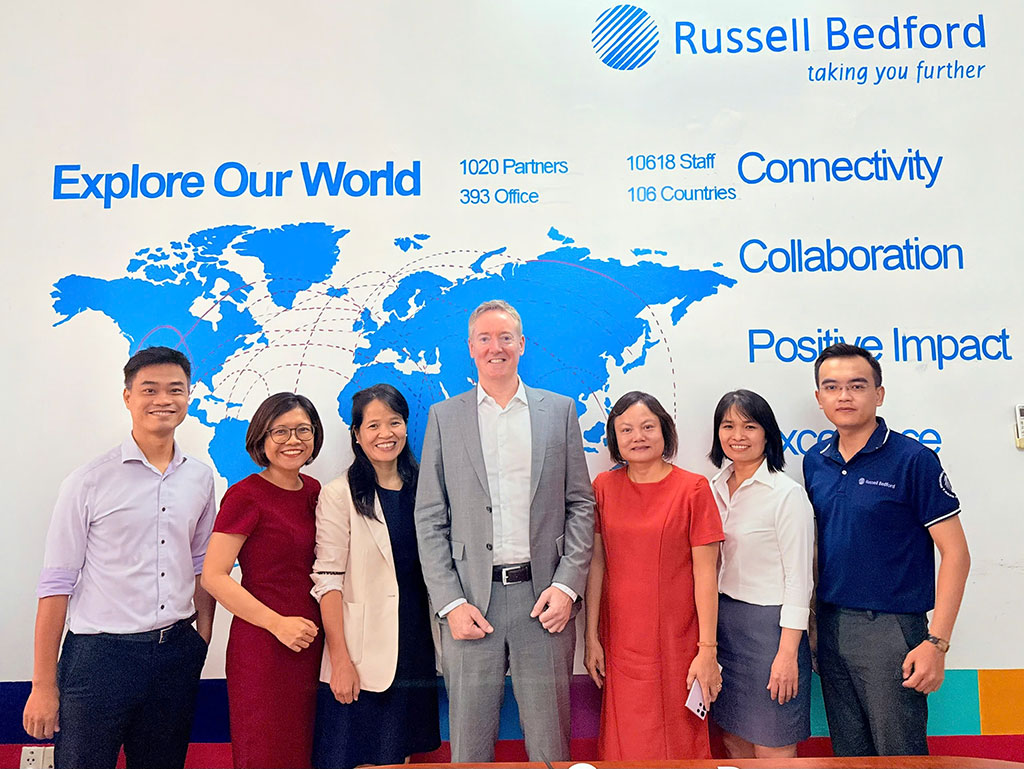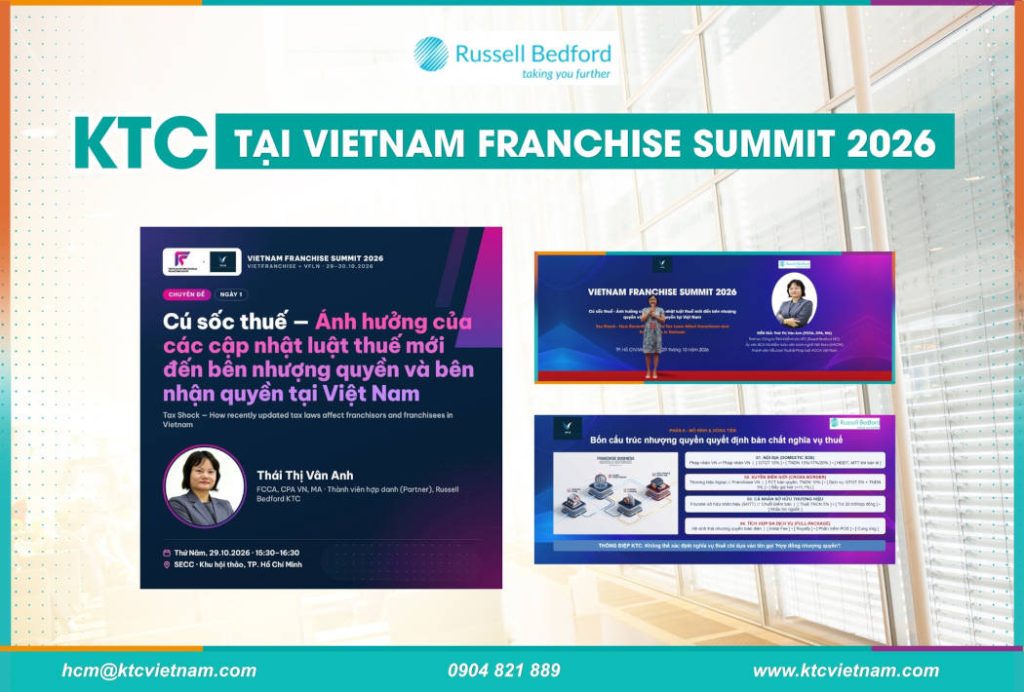
On 29 October 2026, at Vietnam Franchise Summit 2026, held at the Saigon Exhibition and Convention Center (SECC) in Ho Chi Minh City, Ms. Thai Thi Van Anh – FCCA, CPA VN, MA, Partner at Russell Bedford KTC – participated as a speaker in a thematic session titled “Tax Shock – How Recently Updated Tax Laws Affect Franchisors and Franchisees in Vietnam.”
During the session, KTC shared professional insights into tax and accounting matters in franchising, focusing on risks arising from transaction structures, accounting treatments and tax compliance obligations amid ongoing regulatory changes.
1. Understanding the Nature of Transactions in Franchising
A franchise model typically involves various revenue and expense components, including initial franchise fees, recurring brand usage fees, marketing contributions, training and technical support fees, point-of-sale (POS) software fees, as well as transactions involving the supply of goods, machinery and equipment.
Each component has its own economic substance and distinct tax and accounting treatment. Therefore, relying solely on the label assigned to a fee or on broadly worded contractual provisions may not adequately reflect the actual nature of the transaction. KTC emphasized the importance of properly identifying the business model, clearly defining the rights and obligations of each party, and specifying the individual fee components from the contract negotiation and drafting stage.
2. Five Key Tax Issues for Franchising Businesses
Drawing on practical experience in franchising, the presentation focused on five areas that may directly affect businesses’ tax obligations and compliance practices.
Foreign Contractor Tax on Cross-border Transactions
Franchise agreements with foreign partners may include fees for brand usage, training, technical support and software. Each component may be subject to different Foreign Contractor Tax (FCT) treatments. If the agreement does not clearly distinguish the nature and value of each fee, businesses may face risks when determining taxable revenue. Where revenue cannot be separately attributed to each activity, the highest applicable corporate income tax (CIT) rate among the relevant activities may be applied to the total contract value.
Related-party Transactions and Supply Chain Requirements
Franchisors may impose requirements regarding sourcing arrangements, suppliers, purchase prices or operating procedures. However, such requirements do not automatically establish a related-party relationship for tax purposes. Businesses should review the degree of control or influence between the parties against the regulatory criteria for determining related-party relationships, in order to identify the risk of transactions being classified as related-party transactions and the associated compliance obligations.
Marketing Contributions and Deductibility Requirements
Contributions towards the franchise system’s shared marketing activities should be supported by clear documentation of their purpose, contractual obligations and actual implementation. In addition to payment evidence, businesses should retain marketing plans, records of activities performed, acceptance documentation and the basis for cost allocation. Making a payment does not, in itself, mean that the expense automatically qualifies as deductible for corporate income tax purposes.
Value Added Tax and Invoicing in the Supply Chain
Under certain business models, goods may be delivered directly to franchise outlets, while payment and invoicing are handled through an intermediary. If the contracts, purchase orders, delivery records, invoices and payment documents are inconsistent, businesses may encounter difficulties in filing VAT returns and assessing their eligibility to claim input VAT credits.
Tax Obligations of Household Businesses within Franchise Systems
Where outlets within a franchise system operate as household businesses, companies should pay attention to changes in tax declaration and administration requirements. Revenue data should be reconciled across point-of-sale (POS) systems, bank account transactions and e-invoices, including e-invoices generated from cash registers where applicable. Such reconciliation is particularly important for franchise systems operating multiple outlets or undergoing expansion.
3. From Revenue Recognition to Actual Financial Performance
A key topic addressed during the session was the difference between the timing of accounting revenue recognition and the timing for determining tax obligations.
For example, in the case of an initial franchise fee collected as a lump sum, accounting revenue may, in certain circumstances, be recognized or allocated over the period in which the contractual obligations are fulfilled. Meanwhile, the timing of invoice issuance and the determination of taxable revenue must be assessed in accordance with the relevant regulations. Failure to distinguish these differences may result in discrepancies in financial statements and tax declaration and finalization records.
Through a simulated case study of a food and beverage (F&B) outlet, KTC illustrated that revenue and profit recorded in the books may not fully reflect actual financial performance if related tax obligations and compliance costs have not been taken into account. Businesses should maintain a periodic reconciliation process covering sales data, the basis for calculating franchise fees, invoices and supporting input documentation.
4. Tax Readiness – A Foundation for Sustainable Franchise Growth
Tax risk management in franchising should be embedded throughout the entire business process, from contract structuring and transaction arrangements to accounting recognition and the standardization of supporting data and documentation. Standardizing fee components and aligning financial data are important foundations for businesses to accurately assess their financial health and readiness to expand.
Concluding the session, KTC highlighted its key message: “Tax Readiness is Franchise Readiness” – readiness in tax management and compliance is a solid foundation for building and growing a sustainable franchise system.
Russell Bedford KTC supports businesses in reviewing franchise agreement structures, assessing tax risks and standardizing accounting and audit processes. Please contact KTC for further consultation and support.